|
|
|
Home--Campaigns--Coca-Cola
Exporting Junk Food - Good for Business, Bad for Health
If Junk Food is Bad for Americans, Are They Good for Indians and
Chinese?
by Amit Srivastava
India Resource Center
June 4, 2010
Last month, in a bid to preempt any binding government action, sixteen
food and beverage companies announced a pledge to reduce 1.5 trillion
calories from their products in the US by the end of 2015 - ostensibly
to fight obesity in the US.
Indeed, the growing obesity epidemic in the US has caught the attention
of the White House, and Mrs. Michelle Obama in particular.
The announcement by the Healthy Weight Commitment Foundation - comprising
some of the largest food and beverage companies in the US - came just
five days after the release of the White House Task Force on Childhood
Obesity Report to the President, part of Mrs. Obama's Let's Move campaign
designed to address the growing obesity epidemic in the US.
The White House Task Force report and its recommendations suggested
that unless the industry made significant changes in the way it markets
unhealthy junk food to children in the US, government policies could
be introduced to make them do so.
Whether the announcement by the companies - which is short on the
details - is a genuine commitment to reduce obesity or a public relations
maneuver to appease Mrs. Obama and the White House remains to be seen.
What is significant, however, is that the fast food industry in the
US and its role in marketing and selling unhealthy junk food to Americans
is being widely accepted as a big part of the problem of the obesity
epidemic in the US.
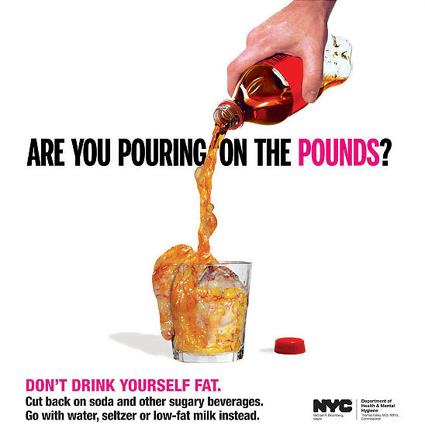
New York City Campaign Against High Sugar Beverages
|
|
According to the U.S. Centers for Disease Control and Prevention,
two-thirds of American adults and 15 percent of American children
are overweight or obese, and consequently, at high risk of developing
heart disease, diabetes and cancer.
The obesity epidemic has become so alarming in the US that it led
to more than 130 retired generals, admirals and senior military leaders
to frame the issue as a national security threat, writing that, "Obesity
rates threaten the overall health of America and the future strength
of our military."
Consumers in the US are slowly becoming more nutrition-savvy - increasingly
reading food labels and rejecting high-fat, high-sugar and highly
processed products. Much more needs to be done however, to contain
the abundance of cheap and empty calorie intake which is ubiquitous
in the US food landscape today.
Mrs. Obama's focus on the food and beverage companies is not the first.
It bolsters the efforts of New York city, which has been a leader
in campaigning against trans fat, then high sugar beverages, and now
sodium. And California has not been far behind, banning the sale of
high sugar products and other junk food in public schools, for example.
So it comes as a major disappointment that while companies like Pepsico,
Coca-Cola, Unilever, Nestle, Kraft Foods and the like have pledged
commitments to reduce calorie intake and fight obesity in the US,
these very companies are extremely busy ramping up their presence
in the developing world, and China and India in particular.
Pepsico just announced a $2.5 billion investment in China to increase
its beverages and snacks industry. Earlier this year, Pepsico announced
a $200 million investment in India to expand operations. Coca-Cola
announced an additional $250 million investment in India in 2008 to
build more bottling plants and increase its market share. McDonalds
just announced an additional $20 million annually to open 30 outlets
each year in India.
Rapid expansion in the emerging markets may make good business sense
from the perspective of these companies. Consumers in the US and other
mature markets are becoming increasingly savvy to the negative health
impacts of these products. And these companies are struggling to grow
in the developed economies.
But if high-fat, high-sugar and highly processed foods are bad for
the health of Americans, are they any good for people in India and
China?
The answer, obviously, is a clear no.
Increasing investments in the developing world by these peddlers of
junk food is a clear case of double standards. While these companies
are pledging to reduce calories in the US to tackle obesity, they
are simultaneously expanding their markets - with junk food - in the
developing world.
Junk food is the last thing that China and India need - both countries
are already experiencing startling growth in obesity and related health
problems.
A recent government survey in India found that more than 20 percent
of urban Indians are overweight or obese. And India was, until recently,
the diabetes capital of the world, according to the International
Diabetes Federation, only to be overtaken by China.
China is also experiencing a rapid rise in obesity. 30 percent of
Chinese adults are overweight or obese today, compared with 25 percent
in 2004. "More than 92 million Chinese adults suffer from Type-2 diabetes,
caused mainly by a high-calorie diet and sedentary lifestyle, according
to a study in the March 25 New England Journal of Medicine. Based
on this data, the International Diabetes Federation in Brussels estimates
close to half a billion Chinese will have the disease in 2030."
Although one cannot blame the rise in Western junk food as the sole
or even primary reason for the alarming rates of obesity and related
diseases in China and India, it is clear that adding more high-fat,
high-sugar processed foods in these markets will significantly worsen
the problem.
It also makes absolutely no sense for already overburdened public
health systems in India and China to be inundated with more junk food
related illnesses as the result of an expanded western junk food regime
that have been found to be central to the growing obesity epidemic
in the West.
If these food companies were serious about the social responsibilities
that they so often tout, they would approach the growing obesity rates
in India and China just as they have pledged to do in the US - by
not adding any more calories and in fact, reducing calories in the
developing countries.
It will be the right thing to do. People's health and people's lives
in developing countries are as valuable as in the US.
So why the double standard?
Amit Srivastava is the coordinator of the India Resource
Center, an international campaigning organization based in the US
and India.
|
|


PRESS: Coca-Cola Forced to Abandon $25 Million Project in India
PRESS: Coca-Cola Expansion Plans Rejected
PRESS: Coca-Cola Plant Shut Down in India, Authorities Cancel License
STUDY: Coca-Cola’s Operations in India Lead to “Tragedy of the Commons”
PRESS: 15 Village Councils Reject Coca-Cola Plans as Opposition Grows
Mehdiganj - The Issues
PRESS: Coca-Cola Expansion Plan Opposed in Mehdiganj, India
Support Us
Join Us
>> More
Stories

|



